


ChatGPT click traffic seems to have dipped pretty hard in recent months for just about everybody. In the long term view, however, AI search clicks are steadily growing.
Relaying this story to your boss can be tricky. Bottom-line: I think the recent dip in clicks is a data attribution issue. I’ll show you what I mean in this article.
Of course, we’re all working with limited data, thanks to these hyper-secretive AI companies. Finding answers requires some digging. Here’s what my team found.
Clicks from ChatGPT seem to be down across the board
Down, that is, from last year’s astronomical rise. I think this is important context: from Oct. 2024 to Oct. 2025 the rise of clicks from GPT was astronomical. After ChatGPT updated its UTM practices last summer, nearly every website I know saw an even more dramatic increase in documented clicks from ChatGPT.
Across scales and industries we’ve seen trends like this for many companies. Dylan Stark breaks it down in this short video. 👇

And yes, we’ve seen that steep drop-off from last summer’s peak, but overall the clicks are still much higher than they were a year ago.
So it’s worth wondering: does this measured dip reflect changes in user behavior or tracking protocol?
Dramatic drop-offs are nothing new
If you’ve managed Google search metrics for a brand then you’ve likely seen a few spikes and dips of this nature before. That SEO experience can ground how you make sense of this GEO stuff.
When dramatic shifts like this happen in traditional search, is usually one of three things:
- A change in search protocol. The search engine has new rules about how it values and prioritizes content. (Like Google’s Helpful Content Update, for example.)
- A change in data tracking protocol. The search engine changes how it identifies different user behavior. (It changes UTM practices, for example.)
- A change in actual user behavior. The dip in metrics is an accurate reflection of users clicking links less often.
When you see huge drop-offs across a variety of websites and circumstances then it’s probably not a user behavior issue. In the current instance, where the drop is exceptionally uniform across websites and content, this points to a tracking issue rather than anything to do with content.
Google is nobody’s friend but at least they document big protocol changes for the public. These AI platforms are decidedly more cagey about their updates.
Meanwhile, AI search traffic keeps growing overall
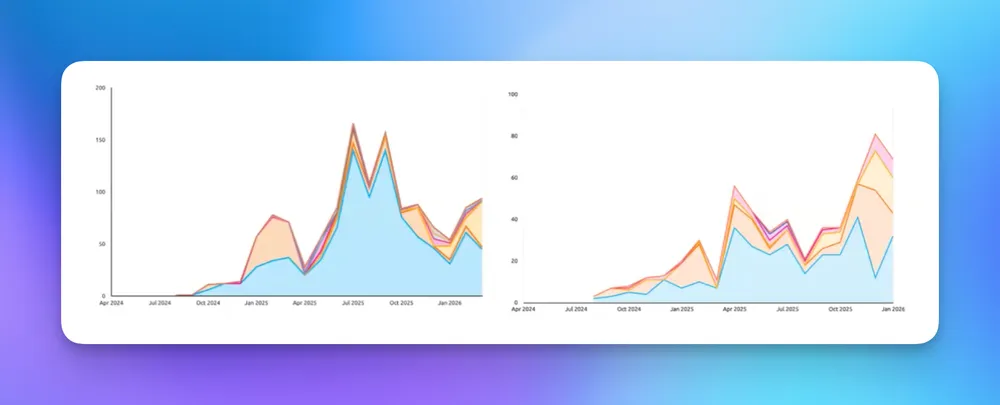
We’re still seeing a steady increase in AI search clicks across all platforms.
Below are some anonymized trend charts for different clients. They compare inbound traffic from an assortment of the big AI platforms. (ChatGPT is in blue while the other colors represent Perplexity, Gemini, Bing, etc.)

As you can see, they all continue to show consistent upward growth. AI search is still generating modest search traffic when compared to traditional Google search, of course, but as a channel it continues to show promise.
What is disappearing, I think, is the referrer info, especially from ChatGPT data. In other words: the huge decline in click data doesn’t necessarily represent a huge decline in actual clicks.
Signs point to a data tracking issue, not a usage issue
It’s easy to get frustrated with ChatGPT because it commands such a big user base. (I mean, you could get real data from Bing but that’s only going so far.)
None of the big AI platforms are particularly helpful when it comes to sharing or parsing data.
- Mobile versions strip referrer data. This seems to be true for ChatGPT, Claude, and Perplexity alike.
- Desktop vs web versions vary in their tracking. Perplexity’s web version provides referral trackers, for example, but its desktop version doesn’t.
- Every company has their own bespoke policy for this stuff. Claude, for example, is known for being a little tighter with referrer information. Perplexity is more open.
But all of these things are subject to change and there is no real standardized policy for any of it. So ChatGPT can change referrer tracking policies on a whim and the rest of us only find out when we do some digging.
Direct traffic data is suddenly much more useful
There’s a longstanding issue with ChatGPT traffic registering in GA4 as “direct traffic” (i.e. traffic that comes from someone typing a URL directly into their web browser).
This direct traffic has two main sources when it comes to AI search:
- Authentic, direct traffic. People use GPT to get a list of products then investigate those product websites directly on their own, without clicking from the links provided.
- Click traffic, poorly categorized. As mentioned above, a lot of click traffic is simply not given a discernible referrer label.
When it comes to AI search, both scenarios are quite prominent. As AI search usage has increased we’ve also seen direct traffic increase for our clients.
Direct traffic, in this context, is a measure of content success. What used to be a catch-all category for unlabeled traffic now has more clear implications. We should start treating it as such.
That is: start analyzing the connection between direct traffic and conversion actions.
AI search performance is bigger than clicks
Clicks are important, of course, but they’re only one level that brands should keep an eye on. This is true of all channels. It’s even more crucial when the channel (like AI search) provides scant, unreliable data.
Even if click data was entirely reliable, it still doesn’t tell you the search queries that led to those clicks. In the absence of query data, all you’re really getting is a sense for which AI platforms are generating the most traffic.
That’s why companies track brand visibility in AI search. They do it with subscription tools like Profound or bespoke data collection workflows.
This data provides a lot more context. It also works as a proxy for click data. AI platforms are still keeping actual click data under wraps, for now. Piecing together a detailed view of content performance requires using every bit of data we can find.