


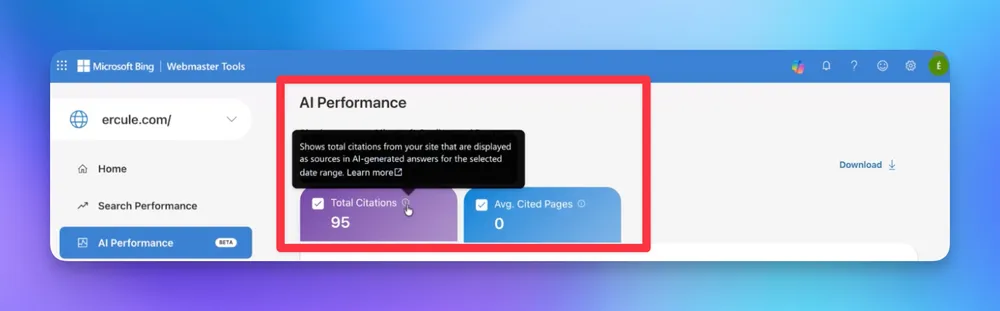
Say what you will about Bing... They just released a new data feature that GA4 users have long been waiting for: real, first-party data on AI search performance.
Bing’s user base is small compared to Google’s, of course, but the quality of data it’s offering is unprecedented in AI search.
So, once you’re done rolling your eyes, I’d like to show you a few things:
- How this data differs from the other options out there.
- How you can access it via Bing.
- How you might use it for AEO.
Up until now, all we’ve had is proxy data
ChatGPT, Claude, Gemini, all of the big players still keep all of their query data under lock and key. That means that any person (or product) with AI search data is collecting it on their own.
Currently, the most reliable metric for understanding AI search performance is brand mentions. People (and high-priced tools) are generally using the same process to get that data:
- Send a bunch of targeted queries to LLMs
- Measure how frequently your brand is mentioned in response.
- Measure the mentions of your brand’s top competitors.
- Analyze the results.
Doing that at scale is complicated, of course. These tools are sophisticated, and their results are practical, and consistent, and yet…
Even the best AI search data tools are winging it
Profound is a popular (and reliable) tool for this kind of measurement. It provides you with a brand visibility score.

Profound generates this score by sending a variety of targeted queries to a variety of LLMs and then analyzing the results. These tools are robust — but, on the most basic level, they’re plugging queries into LLMs, one after another, like this…

In the above example, I typed a query into Claude: what's the best accounting software for a small marketing agency or a small business? Claude responded with a list of brands: FreshBooks, QuickBooks, Xero, Harvest, etc.
Quantify those kinds of results at scale and you start to have a practical data set. I’m a fan of this approach. We even have our own bespoke tools that run those kinds of research. We do it because this method is useful! But it’s not precise.
This kind of guesswork has real limits
There’s one question that none of the established tools can answer (and it’s a big one).
How often are real people actually typing these queries into LLMs?
This data is crucial for allocating resources in your budget. Not all queries are equally popular, so not all queries are equally valuable to a marketing campaign. We need search volume data in order to predict which topics will be worth the investment.
By way of analogy, consider keyword volume data. You might have a long list of potential keywords to target, but not all of them are equally popular. Data about keyword volume (aka search volume) enables you to steer towards the phrases that are most common. Without that kind of data you might sink your resources into answering questions that none of your buyers are actually asking.
Third-party data does, too.
The other problem with these third-party data tools is that they’re third-party data tools. This data doesn’t come directly from search engines.
Returning to the analogy of keyword data: third-party tools like SEMrush provide statistical approximations of search data while Google Search Console gives you authoritative (first-party) data from Google itself.
Again: the third-party approach is reliable and practical and fills a major gap in knowledge. But I also want the most authoritative data possible. Bing doesn't completely answer all of the questions we have about LLM visibility but it’s providing first-party data. That’s unprecedented.
So welcome to Bing, fellow snobs
You’ll find the AI performance data is in Bing Webmaster Tools, which is basically the Bing equivalent of Google Search Console. You’ll see some obvious design similarities to GSC…

Let’s get into this new AI Performance data.
What kind of AI Performance metrics does Bing offer?
The new AI Performance tab provides you with actual citations from the AI search tool known as…. *drum roll please*... Microsoft Copilot.
Now I know (I know!) Copilot is not Claude and it's not ChatGPT – but it is an AI tool that people use to navigate the web. And it’s providing real data. Claude and GPT don’t currently provide anything like that.
What can you look at with this data?
- The actual queries that are leading users to your site.
- How many times your content has been cited over time (along with trend charts that show how the number has changed over time).
- How many pages on your site are being cited.
- Which pages are being cited, surfaced, and clicked.
Simple, clear, practical data.
AI citations and cited pages
The AI performance view has two main tabs…

- Total Citations.The total number of times that Bing’s AI experiences cited (or referenced) content from your website in generated answers.
- Avg. Cited Pages. The average number of unique pages from your site that were cited by Bing AI over a selected time period.
Grounding queries
You might think of grounding queries as the LLM search equivalent of keyword or topic data. Grounding queries identify key phrases used in actual queries.
In the screenshot below you’ll see a citation metric: my own website was cited 30 times in queries related to the topic of content systems.

We’ve only recently started targeting that topic so this LLM search data is showing that we’ve gone from zero to thirty. That's real progress for a new campaign in just a few weeks.
It’s also showing citations for a phrase that we haven’t actively been pursuing although it does align with our brand: scalable content distribution SEO. This data can surprise you like that. You’ll find interesting opportunities that you may have never considered.
Pages cited
The “Pages” view shows you citation, impression, and click data for every page of your website that is actually being cited in AI search.

When I’m helping clients optimize their content, no matter the channel, I always recommend they start with the pages that are generating the most engagement. We now have metrics that can guide this task in AI search as well.
Will Google start providing this AI search data?
Bing’s “AI Performance” view gives me reason to believe that GA4 won’t be far behind. I mean: nobody wants to be bested by Bing, right? And, just as Microsoft has Copilot, Google has Gemini. So Google has some data to share.
Still, AI data in Google Search Console is far from guaranteed. After all, Bing Webmaster Tools has a bunch of features that Google Search Console never bothered copying.
I’m not trying to be “Mr. Bing” here
I’m just saying: it has a practical data set that you won’t find anywhere else right now. Also, setting up your account in Bing Webmaster Tools is super easy. If you have Google Search Console set up then you can import those sites directly into Bing.
Besides, the learning curve for AI search performance is only going to get steeper from here on out. You might as well learn how to handle it now while the landscape is still (relatively) spare.