


No. You do not need a separate AEO budget. Fold answer engine optimization into the SEO line you already have — typically 6–10% of marketing spend — and measure citations and pipeline, not a new channel tax. Marketers are spending money on SEO and AEO, but it is rarely obvious whether the split is right, because organic does not return a coin per coin the way paid often does.
It’s tough because the balance sheet for SEO and AEO isn’t as tidy as it is for other channels. SEO isn’t a gumball machine. You can’t expect discrete, transactional returns for every coin you invest in them. Some channels (like paid ads) work that way, but SEO and AEO really don’t.
With that in mind, this article isn’t going to be prescriptive. Instead, I’m going to look at…
- How much marketers are typically spending.
- How those funds are allocated.
- Which data you can use to validate the investment.
SEO and AEO occupy 6 - 10% of the marketing budget
I work with companies of all sizes. Some have huge marketing teams, others are one-person operations. So, rather than talking in hard dollar amounts, I want to talk about SEO budgets in relation to your overall marketing budget.
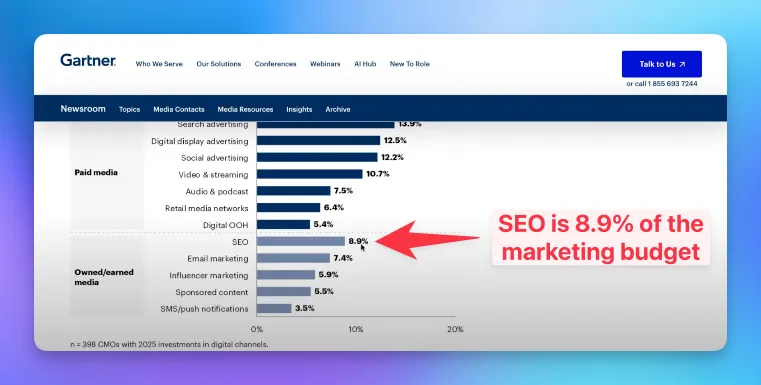
Looking at a few different sources, I’ve landed on a 6-10% range that seems to hold across industries. Let’s get the big-guy industry report out of the way first: Gartner’s 2025 CMO spend survey shows that SEO is nearly 9% of the marketing budget, on average.

(Also: marketing budgets are about eight percent of overall revenue.)
Notably, the respondents here were mostly very big companies “with the vast majority of respondents reporting annual revenue of over $1 billion.” Your company (and my own humble marketing agency) might be pulling in a smidge less than that. So let’s look at the marketing budget for a successful brand that’s smaller than a juggernaut.
How about an AEO-specific budget line?
Let’s look at one more study – this one published by Conductor.

Nearly half of respondents said they were devoting 10-20% of their digital marketing budget to AEO /GEO. If you calculate that relative to the overall marketing budget then it comes in around 7-10% of total marketing spend.
Storylane’s SEO budget is closer to 6%
I was really inspired to write this article after reading this post by Madhav Bhandari. He's the head of marketing at Storylane. In that post, Madhav breaks down his ($3.3 million) marketing budget.

The most shocking thing about Madhav’s budget document, to me, is that he posted it on a social platform. I’ve seen plenty of companies with similar budget breakdowns but none of them were willing to share them. I admire Madhav’s candor here. He's spending…
- About 1/3 of his budget on paid ads.
- About 1/7 of his budget on events.
- About 1/16 of his budget on SEO.
Again, I’m not interested in the $200,000 he’s spending on SEO. I’m interested in how it relates to the bigger budget. In Storylane’s case, it’s about 6.1% of the marketing budget. Madhav’s document doesn’t specifically mention AEO. Which brings me to my next point…
AEO folds nicely into the SEO budget
How you designate SEO and AEO in your own budget is up for debate. Still, across these reports, I’m seeing a window of 6 - 10% of the marketing budget earmarked for SEO and AEO.
I recommend combining both of them within one budget item labeled SEO. Assign 10% of your marketing spend to it. AEO and SEO are not exactly the same but the labor required for both is extremely similar. For starters, written content is the primary medium for both channels.
AEO and SEO campaigns are fundamentally similar
Growing your impact in both channels is dependent on one consistent set of principles:
- Visibility. Before you can win clients, they need to know you exist. Conversions are downstream of traffic, which is downstream of search visibility.
- Authority. In terms of AEO and SEO, authority depends on publishing a breadth of content that proves your unique expertise on the topics that are most central to your brand.
- Targeting. Every piece of content should be designed for a specific audience and the unique problems or questions they have.
- Freshness. People have no patience for outdated content and search engines don’t either. Staying current and useful requires regular updates and maintenance for each page.
- Monitoring. Building momentum and expanding reach with content requires active attention to performance metrics.
There are some significant differences between AEO and SEO. The analytics for each channel require different tools, for example. Yet the work and outputs required for both channels are very similar. And, since SEO is a more commonly understood line item in budgets, it might streamline the approval process to fold AEO into your SEO budget for the year.
So I generally suggest folding the two together.
The popcorn machine notion of marketing budgets
Beloved marketer Dave Kellogg introduced me to this idea of marketing being like a popcorn machine: “You’re never sure which kernel is going to pop, when, but if you add this many kernels and this much heat, then some percentage of them normally pops…”
As marketers, we invest in content and ads and events and influencers and all of these things in order to get a net return on the overall investment. What looks random or unpredictable in the short term, by Dave’s logic, often proves comprehensible in the aggregate.
Some of those elements are easier to measure in the short-term. Paid ads, for example: you invest X number of dollars and get Y number of dollars’ worth in sales. I invest a dollar and expect to get five dollars’ worth of leads in return. It’s more like a gumball machine than a popcorn machine. The balance sheet is very easy to track.
The overall marketing budget is not nearly so tidy. Channels like SEO and AEO, in particular, don’t operate on such a neat exchange of investment and return. Reporting and KPIs and accountability are built into the systems, of course, but they generate returns on investment that same popcorn machine way.
What actually goes into the AEO / SEO budget?
I believe that most of the budget is going into content production, management, and infrastructure.
- Strategy and orchestration. You’re paying for labor that goes into campaign research, planning, design, team alignment, and overall orchestration.
- Production and distribution. The lion’s share of the budget here is going to writers, and editors, but also LLM assisted tools.
- Analytics and reporting. Free tools like GA4 are available. Implementing them might require additional labor.
Sometimes people put web development in here. I would tend to count that as marketing infrastructure. (This is where the “popcorn” notion of marketing is useful.)
Management is an underrated part of the SEO / AEO budget
We’re dealing with more content and more data than ever before. If you don’t prioritize the management of it all then it quickly makes a mess. In addition to the traditional planning and project management roles you need someone to keep an eye on whether these campaigns are actually working. Someone to actively pull performance reports, analyze them, and revise strategy accordingly.
SEO has always been pretty systematic. In the age of automation and AI, the systemic approach to content is even more crucial. Our creative energy is required less in the production of content and more in the management of content.
To me, the bottom line here is alignment and budgetary efficiency. If the workflows aren’t aligned, and the people on your team aren’t all moving in harmony, then the budget is going to drag. I’ve seen too many clients struggle like that.
How do you validate the value of these channels?
Organic content is largely created for SEO and AEO campaigns but, I believe, this content is helping your brand on a much wider variety of channels.
With that in mind, I’m a big fan of mixing traditional content performance KPIs alongside some that speak to the influence of content on the overall buyer’s journey.
For outcomes, you might think about these metrics:
- Clicks from search. Classic SEO metric, which is also useful for AEO. Note: AI search has much lower click-through rates.
- Brand visibility. How frequently is your brand mentioned in targeted queries and industry-specific recommendations?
- Influence on pipeline. How many qualified leads are being generated by content individually and on the whole? How often are people finding your site through AI search?
- Non-converting visitors. How many people found your content even if it didn’t lead to an immediate conversion? The buyer’s journey is non-linear.
- Sales FAQs. How often are sales teams using your content in correspondence with leads? How often are their FAQ documents part of the closing process?
All of these metrics should be pretty movable in the short- and medium-term. The data can help you make that case for future investment in SEO and AEO. A lot of the data that you need is out there for relatively low cost (and often for free).
You can’t budget effectively without a content system
So how much should you be spending on SEO and AEO? Ultimately, the answer to this question is in perpetual flux. You can’t really answer it until you implement a real strategy and start tracking the results.
Hopefully, when you’re talking about budget with your stakeholders, they’re looking at the ROI for your overall marketing budget rather than the SEO and AEO contingents. On the day-to-day, however, you’re going to work out the budgeting for those channels. To me, it comes down to two main budget lines:
- Labor. People to strategize and orchestrate the content system. People who can generate and optimize content.
- Tech. Automation tools for content generation and optimization. Analytics tools for performance monitoring and reporting.
All investments in SEO and AEO really trace back to those two things. You need smart folks to guide the programs. Those folks deserve the kinds of tools that will enable them to do the best job possible.
Frequently asked questions
Do I need extra budget for AEO?
No. Treat answer engine optimization as part of SEO, not a new channel tax. The writing, research, and updates are largely the same work. What is new is measurement tooling and a bit of structure (FAQs, extractable sections, citation tracking).
Who should own the AEO budget?
The person who already owns organic / SEO. A separate GEO silo usually duplicates briefs, topics, and writers. Shared topics, split by format and by the tools you use to measure each channel.
How do I get budget approved for AEO?
Do not sell it as a new tax on the marketing budget. Show pipeline influence plus citation and visibility, the same way you defend SEO. Paid channels look like a gumball machine. Organic looks like a popcorn machine: you can still account for the batch.
What is a reasonable monthly budget for AEO?
There is no honest single dollar number that fits every company. Across the Gartner CMO spend survey, Conductor’s AEO/GEO report, and public budgets like Storylane’s, SEO plus AEO tends to land around 6–10% of the marketing budget. Use that range, not a round figure I invented.
How do I allocate budget between AEO and SEO?
Same people, same topic list. Spend the extra on measurement (LLM visibility, referral from AI products) and on formats that extract well: FAQs, comparison pages, current product context. Do not split the team down the middle.
Can we start AEO with zero extra budget?
Yes. Structure, FAQs, and freshness on the library you already have will move citations before you buy another tool. Add budget when you need dedicated monitoring or more production capacity.
Is AEO the same as GEO?
Mostly the same job under two names. We use AEO. For the practice, start here: Getting started with AEO.