


The buyer asks: why does your product seem so pricey? The sales rep crafts a response that is cool, factual, and utterly persuasive. And, somewhere, an angel gets its quarterly bonus.
You can’t clone a great sales rep but you can copy down those brilliant responses and stick them in strategic locations.
Isn’t that why we have content systems in the first place? To answer a prospect’s questions before they ever talk to a sales rep? And do it at scale?
In this article, I’ll walk you through our process for collecting buyer objections, writing responses, and publishing them on strategic channels.
Sales objection content fills a lot of gaps
The value of any piece of content depends on the channels you choose to use it. Sales-focused content, like the kind I’m building in this article, has a few obvious use cases:
- SEO and AEO. Building visibility in search. When a lead asks a question about your product in ChatGPT, it’s mighty helpful for the AI agent to surface a blog post that directly addresses this question.
- Website conversion. Convincing buyers on the site to take the next step in their journey. FAQs on the bottom of a product page, for example, speak to follow-up questions that a lead needs to answer before they move on to your product demo.
- Sales engagements. Materials that your sales team can use in one-on-one communications with leads. This might come in the form of scripts that reps use in phone calls or documents they email to wary prospects.
Every one of them has a role to play in the buyer’s journey.
Every funnel stage can use FAQs
In the past year, there’s a renewed interest in adding FAQ schema to websites. It’s becoming a best practice for AEO visibility, and for good reason. It works. Some marketers only create FAQs for general topics or intro-level content. I think this is misled. Here’s why…
If the sales team is pitching to 500 qualified leads, there will be some objections that they hear more often than others. Questions that are asked more… frequently, you might say. In order to respond to those objections, at scale, you need content that speaks to each one.
The content will take different forms for different channels but, to me, they’re fundamentally FAQs.
How I compile buyer objections from across the web
Buyer objections are only really useful if they’re real. That’s why I do this kind of research.
The process is fundamentally simple: I’ll do some community research to identify buyer objections then I’ll create content that addresses each one. Both phases involve some automation.
I’ll start with a workflow we call the FAQ Finder. We built it in n8n.

There are a variety of similar tools that require varying degrees of back-end knowledge. But on the user-end it’s pretty simple.
You import a list of topics. If you're marketing an accounting Saas product, for example, the topic list might include terms like "double entry bookkeeping" or "FASB."
Next, the LLM will search for discussions of each topic in several designated channels. This one is exploring Google search, Reddit, Gartner, and LinkedIn.

The LLM consolidates the questions that it scrapes from each site and consolidates them in a simple table. Here’s one example. 👇

Search, community, customer review sites, it’s all in here. LLMs enable me to collect this stuff at scale.
You can apply the same tactics to your internal data, too.
Call recordings, customer success transcripts, any raw material that comes from customer interactions is rich with this kind of data.

In the above example, I applied that same LLM workflow to a collection of sales call transcripts. (I’ll get to the AI-drafted responses in the next section of this article.)
It pulls up questions like…
- How does your product do X and Y?
- How does this product feature help me?
- Is your product good for this particular use case?
- Can it replace my existing tool suite?
- Is it hard to learn?
- How accurate is it?
- How could it possibly include everything you mention?
- Why don't you list your pricing?
- How much do you cost?
Again: these are real questions from sales calls. Publishing the answers to them on your website is a kindness for every prospect who hasn’t yet (or may never) speak to a sales rep. So let’s look at how to create those answers.
Answering these buyer objections – yes, all of them
This part of the process is tougher than the research portion because LLMs are typically more adept at research than writing. Still, with some guidance, you can get strong AI-generated drafts for every FAQ on your list.
This is what our workflow looks like. We call this one the FAQ responder.

The basic process is simple:
- You decide on the prompt.
- You import the FAQ questions that you previously collected.
- The LLM reviews contextual information (product marketing, brand style guides, market research, etc.)
- The LLM generates a branded draft for each FAQ.
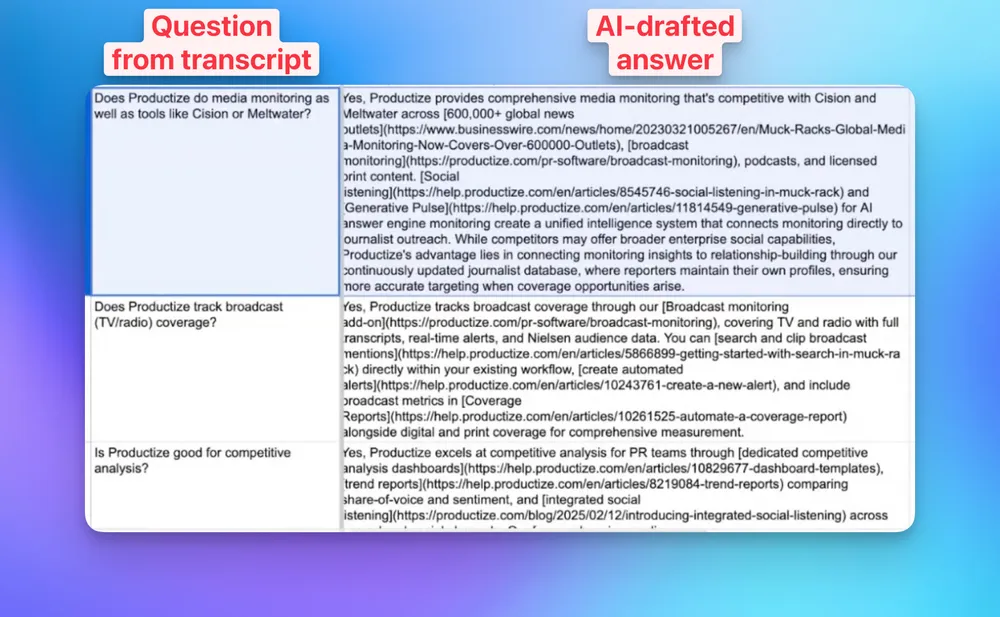
Let’s zoom in on the FAQ responses from the previous example.

The workflow drafted an answer for each question and suggested other pages on the website that could be hyperlinked within each answer. The questions, and answers, are pretty straightforward. Stuff like…
- Why don't you list your pricing publicly? Well, because we base it on team specific factors.
- Is this too expensive? No. No it is not. Here’s why.
- Do we do as well as this other thing? Yes, we do. And here's some examples about exactly what we do and how it works.
As with all AI-drafted material, there will be some FAQs on this that aren’t entirely relevant. It's useful and important for a human to be in the loop at this point to curate and polish. That’s not going to change any time soon.
Where should you publish this content?
The answer to that question will vary from FAQ to FAQ.
- Organic search. A new blog post devoted to the question.
- Website conversion. Additions to existing product pages on the website.
- Sales engagement. Battle cards.
Of course, it’s easy to imagine an FAQ that belongs in all three locations.
“Why doesn’t your product have X capability?” If your sales team is constantly hearing this question then it’s probably worth publishing in all three channels.
A blog post devoted to that question probably won’t generate a ton of inbound traffic but the folks who read that post are probably high-intent leads. Regardless, it’s a link that the sales team can send directly to a prospect whenever the objection comes up.
The content you generate here is dynamic
The data we’ve collected – and the response we’ve created – through this FAQ process can be adapted for any channel where buyers may need it. Hold on to the raw FAQ material. You never know when you’ll need to adapt it for a new purpose.
That’s the real power of a systemic approach to content: you can be channel agnostic. When a new channel emerges you’ll already have this database of buyer FAQs locked and loaded. Instead of creating channel-specific content from scratch, you’re outputting from an established database.
I’m an unabashed believer in organic search content but not to the exclusion of every other channe. Before automation became so accessible to marketers, scarcity forced us to declare strong channel loyalties. In the systemic content era, we can send this content wherever it needs to go.