

In the simpler times before AI, you had a direct line to buyers. Algorithmic channels like SEO and social curated the content provided in search results but they didn’t alter the content itself.
You could feel confident that your audience was receiving your message as intended. That's not the case anymore.
AI search tools like ChatGPT, Claude, and Gemini stand between you and your audience now and they’re mashing up your content into new, unpredictable forms. Let’s talk about how AI is changing the marketing game and how you can keep up.
TL;DR
- AI invents answers when it lacks accurate information.
- AI reduces click-through traffic to your website.
- Buyers may never visit your site at all now.
- AI personalizes responses differently for every single user.
- No brand has mastered this channel yet.
Note: this article is adapted from a longer guide: “How to influence what AI is saying about your brand.”
What makes AI a unique marketing challenge
There are three things that make AI different from every algorithm that marketers have dealt with before.
- It reads everything. Your homepage. Your 2020 blog post. Your retired product positioning. It synthesizes from the whole vat.
- It never says, “I don’t know.” If it doesn’t have access to a real answer then it will make one up and present it (confidently) to your buyer.
- It doesn’t send the click. I mean, sometimes a buyer will click through from AI but more often they get an answer from AI and then move on. Most of the time your funnel never sees them.
This is how AI gets between you and a buyer. It has a ton of information which it uses to provide articulate (and inconsistent) answers for buyers. Those answers discourage click-through. Marketers looking to maintain some influence in this channel will need to deal with all three of these factors.
AI search vs. traditional Google vs. social platforms
SEO and social remain huge channels for marketers. In terms of user bases, they’re still much larger than AI search. So, as AI continues to grow its user base, it’s worth keeping in mind the core differences between the three channels:
- Google shows your content for all to see. You control the message.
- Social platforms control your reach and who sees it. Still, you control the message.
- AI synthesizes everything and writes its own messages. You don’t control the message (and buyers may never even visit your website).

In the AI era, you don't own the message in the same way that you did. None of us do. This fact gets lost a lot in the more technical conversations about AEO, GEO, and organic in general.
We’re all still trying to build audiences with all three of these realities at once. AI is adding new challenges to our daily marketing lives. Like this next one…
The role of websites has changed with AI search
AI reads everything you've ever published and then synthesizes its own answer with or without your participation. Buyers make decisions based on this AI information. Some might never see your site at all.
Sites are still getting traffic, of course. It comes mostly from traditional, SEO-style Google search. AI is an additional class of interactions that we have to manage as marketers. It’s one which we don't control at all.
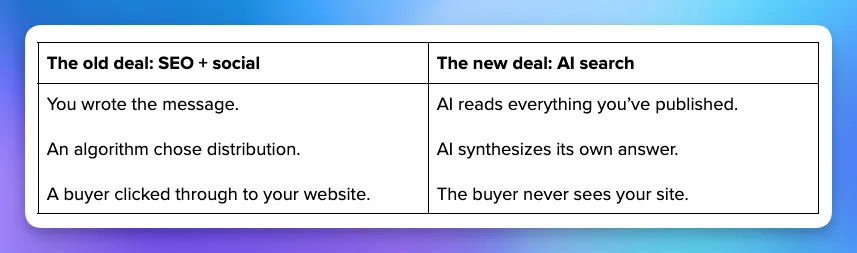
| The old deal: SEO + social | The new deal: AI search |
| You wrote the message. An algorithm chose distribution. A buyer clicked through to your website. | AI reads everything you’ve published. AI synthesizes its own answer. The buyer never sees your site. |
In the old days, a buyer would seek out the “pricing” page on your website in order to get that information. Now they’re bringing those questions to AI instead. AI will always give them answers. The accuracy of those answers, however, is far from guaranteed.
Even if you don’t have any pricing information on your website, and no such information is publicly available, AI is going to tell buyers something about your pricing. If the only information about your pricing comes from a misleading page on your competitor’s website then AI might very well make that faulty info the centerpiece of its answer.
In terms of content and information curation, this is the major shift that we’re all learning to deal with. There’s another big shift, too, in terms of user experience and information presentation…
Personalization in AI search is another unpredictable factor
Personally, I use Claude more than any other AI platform. I use it all day long at work. Claude knows who I am and what I want. It knows how I communicate, and what kinds of data points interest me. It knows how I like information presented, even without me consciously or explicitly stating preferences.
It composes answers for me based on that knowledge. It does that for every user. So, if you and I both ask the exact same question of Claude, we’re going to get two different answers. The content will be different, the style will be different, the citations will be different.
This is a huge change from the broadcast algorithms like SEO and social.
Social media and SEO are curated, not personalized
A traditional Google search would surface the same content to everybody. If it decided that a certain blog post had something to say about a certain topic then it would surface that blog post consistently to every person who typed that particular topic phrase into the search bar.
Social platforms were similarly uniform. If your content on a social platform was engaging then the algorithm would surface that content for users (with maybe some light filtering for demographic profile and preferences).
AI has taken custom curation to a whole new level. It’s tailoring what it shows to buyers and how it presents it. The relationship between user and platform starts to look much more like sales enablement and less like a traditional, algorithmic relationship.
AI is a channel you can actually influence
Losing control of your message sounds alarming, but there's a useful flip side: nobody has cracked this channel yet. Brands that clean up their content libraries and publish consistently on the right topics will get ahead. The new game isn't about gaming the algorithm. It's about making sure that every piece on your website is timely, compelling, and clear.
Look up your brand on Claude right now. If the answer surprises you, that's your signal to start. Our guide to AI brand visibility covers the full strategy. For real query data, Bing Webmaster Tools are a surprisingly good starting point. The marketers who figure this out won't have the most resources. They'll just be the ones who started first.