


There are a handful of topics that are central to your brand’s product, position, and messaging. Ideally, any time a buyer pursues information on those topics in a search engine, AI serves up your content to them.
That dream scenario hasn’t changed much since the early days of Google SEO. Achieving it in the AI era requires a modified playbook, even though the fundamentals remain pretty much the same.
So let’s talk about the structural foundations of a website that is optimized for AI search.
TL;DR
- Outdated content misleads AI about your current brand.
- Topic focus shapes how AI describes your company.
- Fresh content gets cited by AI more often.
- Content gaps get filled by AI on its own.
Note: this article is adapted from a longer guide: “How to influence what AI is saying about your brand.”
Consistency
A consistent message has always been important for marketing but it takes on new dimensions in the age of AI. It goes beyond consistency in the copy you write. You need to also be consistent in the topics you focus on. This is just as true for your archived material as it is for your latest campaigns.
- Brand messaging. Any page that contains outdated brand language is a liability. Any one of those outdated phrases could be parroted by Claude to your buyers.
- Product features. Long-forgotten product pages could work their way into AI responses even if your brand discontinued (or deprioritized) those products long ago.
- Topic focus. If your “data mesh” content from 2020 outnumbers your present-day content about “open data infrastructure” then AI might think you’re still a data mesh brand.
I saw that last example play out in real-time for a client. They asked, “Why does Claude think that my company is a data mesh company?”
The answer was simple: years ago they were, in fact, a data mesh company. Their website still had an inordinate amount of content from that era. AI platforms concluded – reasonably, if incorrectly – that their brand was still all about data mesh.
Claude surfaced a lot of that outdated data mesh content in response to a wide variety of queries. It gave buyers the wrong impression. (It was really excellent content, too. That’s one reason why AI kept citing it, I think.)
Topic selection drives brand visibility
Quality content is only useful when it’s addressing a topic that is strategically important to your brand. Otherwise, it will only confuse AI and, by extension, your buyers.
The screenshot below shows a brand visibility report that I pulled for that same client, the one who was tired of being associated with “data mesh.” The report shows frequency with which a brand is mentioned by AI when specific topics are brought up.
As you can see, the company’s visibility for “data mesh” was actually growing due to the continued success of old data mesh content.

This sort of dilemma is unique to the new AI search age. Up until now, marketers typically just wanted any and all of their content to get more visible. If you were winning in Google search rankings for a few completely unrelated topics then that was no big deal. Google was still going to serve up your content for relevant queries. Once people landed on your website they could quickly figure out for themselves what the brand was really about.
That’s not how it works anymore. Now those off-topic associations are a big deal.
Let’s look at one more example. This is from another Saas company that repositioned its product and brand quite a few times over the course of ten years. It started as an open source tool, then it became a cloud product, then it added new feature sets, different pricing models… Lots of iterations, as is the case with so many ambitious, successful startups.
We collected data about their brand presence in AI, looking specifically at the different ways in which the brand was described in platforms like Claude and ChatGPT. When it came to characterizing the product as a tool, AI provided no less than nine different categories for this brand. 👇

In the SEO era, those kinds of changes would not have been a problem for the brand. In the age of AI, however, all of that variation leads to mixed messages.
Curating your content for strategic topics – and eliminating the non-strategic subject matter – is a necessary first step for making sure Claude gets the message clear. Addressing the topics isn’t quite enough, though. Your library needs to have a significant catalog of content about those core topics.
Depth
The categories in your content library that have the most content should be the categories that are most central to your brand and product.
Developer-led companies are a real success story in this regard because they already have really deep documentation libraries. It’s a necessity for their users. One exciting byproduct: it provides AI with a wealth of detailed material to review. (The “salad bar” is well stocked and fresh, you might say.) So when buyers ask questions about a dev company, AI is able to provide accurate answers.
That’s the exact kind of source material AI needs to make sense of your product and teach other people about it.
Less technical brands tend to have less documentation, which means AI winds up doing a lot more guesswork. In the near future, those brands might wind up creating more technical documentation in order to get the message clear in AI search.
Content serves a new function in this regard. If marketing your product in AI search requires providing more plainspoken context for AI then valuable marketing content might start looking more like developer documentation. Less clever copy, more straightforward diagnostics.
Content with depth requires more collaboration
I’m talking about content that goes deep on the details about how a specific feature works, for example. This is greater technical detail than a content team might be expected to produce back in the SEO era. Generalist copy writers alone will not be able to provide the kind of systemic detail and analysis about products that AI requires.
Get the in-house experts involved: your docs team, your CS team, your engineers. AI platforms are looking for detailed content all over your website. They don’t care if it’s published on the Help page or Docs page or the Blog. (Again, this is where consistency is key.)
Plus, expert voices make any piece of content more original and interesting for real, live, human beings to read. And that is, ultimately, who we’re trying to satisfy.
Breadth
What specific questions are buyers asking about your products? If you don’t address those questions explicitly then AI will. And, remember: Claude never says, “I don’t know.” If it doesn’t have a factual answer then it’s going to fabricate one.
So, ideally, your website should have content that addresses every known buyer question. Questions about product features, pricing, use cases, ROI, onboarding… This is what I mean by breadth in your content library.

In order to cover an adequate breadth of queries you need to first know what queries people are actually asking. There are various ways to get this data. Paid tools like Profound measure prompt volume. Google Search Console will give you data about actual queries: you can see the longtail questions that Claude sends out to Google search. Bing webmaster tools are actually really good for this, too.
Additionally, you can look at social platforms and online communities to identify the questions that people are asking each other, the use cases they’re debating, the industries in which they’re integrating solutions that are relevant to your brand. Those are places that you want to have pretty thorough coverage.
Breadth of audience, too
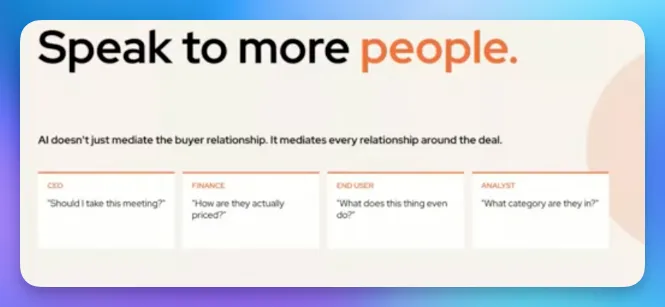
As I noted above, Claude tailors its responses to the individual user. This means that it’s going to provide unique responses to every member of a company’s buying committee.
In the old days, when initial product research required a lot of clicking and backtracking and trudging through Google search, one person was typically assigned to that task. AI has made the process much more fluid.
Your core buyer is presumably doing some initial research with Claude and so is everyone else on the buying committee. So the Chief Security Officer and the Chief Financial Officer are each using Claude on their own to figure out what a product is about. Claude is going to tailor its responses based on what it knows about each of those individuals.

This is another area where content has a new role to fill. In the past, you might not have created content aimed at each of those people (CSO, CFO, CMO, etc.). Today those assets are more important. Claude, your ever-eager intern, is trying to answer questions for all of these different people in the buying committee. The more guidance we can provide it, the better it will do for a brand.
Example: when Claude cites your competitor
This is what happens when you don’t have a pricing page on your website. Claude goes looking for any information at all about your pricing and it finds some on your competitor’s website.
This happened to a client of ours. And – surprise, surprise – the competitor’s content was neither flattering nor accurate.

👆 Just let that sink. Your company might have reasonable, strategic reasons for not talking about pricing on your website. That’s fine. Just remember there are consequences for that strategy now. Somebody else might publish about it. Claude will repeat their opinions. You’re probably not going to like what you see.
I’ve been on the other side of this tactic, too. In the traditional SEO context I helped clients publish pricing pages about their competitors. It worked! The pages ranked well and stole clicks from competitors and drove conversions. AI is eliminating a lot of the clicks from such tactics (as it’s stealing clicks from all tactics) but the risk remains.
Speed
When I talk about speed I’m talking about speed of publishing and updating web content. When selecting content for citation, AI platforms have shown a strong preference for recently published content. The fresher your content, the more visible it will be.
There’s another problem that content velocity can solve: the questions that buyers ask in AI are constantly changing. Marketers need a way to keep up with the latest buyer concerns.
Working with generative AI and context layers
Generative AI is incredibly useful here, both for identifying new queries and creating content that addresses them. The turnaround time from query research to published response is way faster now. Or, it can be, if you have a few tools. We have a lot of content flows that we set up with clients for that purpose.

I’m not talking about slop. Slop won’t help you get ahead in the long-game. In order to create truly useful and engaging content with AI you need a substantial context layer in your workflow.
Remember when I was talking about how dev-led companies have those huge documentation libraries that make it easy for Claude to figure out what they do? A context layer is similar to that database. It provides information and guidance on your brand’s product, voice, style, and end goals so that the content created by AI is unlike any other.
By enabling AI with the correct position and correct messaging you can generate a pretty good draft that responds to any new user question or timely topic.
These systems enable greater collaboration
I’ve been focusing on how customers use AI. Lots of your coworkers do, too. (And if they’re not using it yet then they should probably start getting familiar with it.) When AI gets the message right, all of these people, internally and externally, are better equipped to spread the word about your product.
It might be a sales person who’s making a few new slides. It might be a brand partner who’s building a page on their website about how your product integrates with theirs. It could be the copywriters working on new social media posts.
All of these folks used to rely on internal documentation in order to do their job. Getting the freshest possible data was never easy. Official brand guides and product updates took weeks. Products at startups change week to week.
When AI is dialed in then you can ensure that everyone on your team is getting high-quality information. This is true for your diehard employees who want every possible tool. It’s also true for those other folks who are already leaning on Claude to go the quick-and-easy route.
When we do the work of enabling AI there is this compounding effect. It continues to do enablement work on our behalf. That’s incredibly rewarding.
AI fills in the blanks. Make sure you fill them first.
The theme running through all of this is the same: gaps in your content library are gaps in your brand story, and AI will fill them however it sees fit. The brands that win in AI search won't necessarily be the loudest. They'll be the ones with the most complete, current, and consistent coverage of the topics that matter most to their buyers.
Start by searching for your brand via Claude or ChatGPT or Gemini. Look for gaps, surprises, and anything that's just plain wrong. Try out Bing Webmaster Tools to see the actual queries buyers are asking before they arrive on your site. Once you know what's missing you can start to close the gap.