


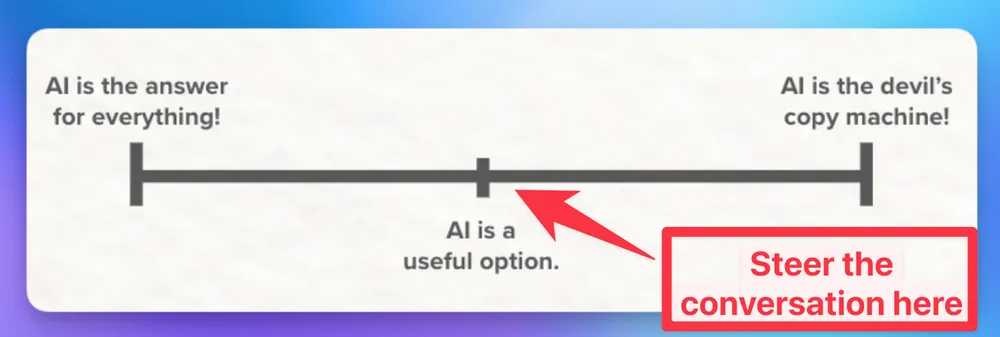
For CMOs and VPs, in my opinion, the process of agentic marketing starts with managing your team’s expectations.
Agentic AI works best, in my opinion, as an additive layer. We add it to existing marketing systems so that marketers can level-up their work. The results so far have been pretty amazing.
Meanwhile, the AI hype economy is promising CEOs that every core cost – from software to entire marketing departments – can be replaced by AI. So managing expectations for your stakeholders is no simple task.
In this article I’ll talk about how you might steer the conversation towards a more measured, additive type of agentic marketing. Then I’ll get into what the first steps look like.
“Why are we still using Salesforce when we can have AI run our CRM?”
The CEO comes in hot like that and you can hear all of the jaws on the Zoom call clench.
The logic underpinning the question is sound enough: big platforms like Salesforce or Wordpress or Hubspot are expensive while AI seems pretty cheap. And people are constantly talking about how AI can replace anything. So why not put it to work?
Here’s my short, glib answer. Platforms like Salesforce solve a lot of problems that you only really appreciate after you gut it all and try building a replacement on your own.
First, steer the conversation toward specifics
I’m not saying that companies can’t replace their core tools with in-house AI builds. I’m saying that platforms like Salesforce provide a lot of complex functions and a UX that’s hard to replace.
If it’s going to be done well, in a way that actually improves on existing systems, everyone needs to be on the same page when it comes to the scale and complexity of the task ahead.
- What the existing platform is currently doing for your team. Not only the use cases of the platform but the specific workflows that marketers are using, and the integrations with other tools.
- UX features that marketers require. A marketing tool is only useful if marketers can use it. How can we test and iterate to make sure that our AI replacement is truly accessible to users?
- Maintenance and contingency plans. Who will the in-house marketers call if and when the platform goes down? What will they do if certain email automation functions aren’t up to speed? Can we devote full-time engineers to this task?
You could spend all the time in the world listing functions and contingencies and there will still be problems that you never anticipated.
Salesforce is very annoying (!) and nobody wants to use it (!!) but that product has been developed over years and years. It has a really great integration ecosystem. It’s pricey and imperfect, but an AI replacement threatens to be even more so.
The risk of a rushed AI replacement
It slows marketers down. When you bring in a new martech stack that is tough to use and requires major revisions to existing processes it winds up creating more problems than it solves.
Marketing performance suffers. This happens with fancy paid tools, too. And when it does, the blame falls too often on the marketers rather than the tech. Performance numbers sink, or they don’t meet management’s expectations for the new tech investment. I’ve seen, time and again, marketers get fired for issues that are entirely beyond their control.
Reframe the conversation: AI as an augmentation layer
You can match your CEO’s enthusiasm for AI without agreeing to gut all of your existing systems on a whim. Try this pitch instead: “Let’s use agentic AI to make Salesforce way better.”
I always recommend AI as an addition, not a replacement. Instead of investing in a risky replacement for Salesforce infrastructure, use agents to perform tasks that aren’t being done with Salesforce.
Add workflows and add QA and add automation that you did not have before. And then, when all that is working, sure: let’s talk about replacing some of our core systems with AI builds.
I know that any savvy company, with ample resources, can build great systems with agentic AI. But your job is not to innovate in CRM technology (unless you work at a CRM company). Additive use of AI will get you more bang for your buck – and minimize risk.
Additive functions are nearly limitless
Big platforms have great places for AI to interact. When the CEO suggests replacing Salesforce with AI you can respond with this additive vision.
- Let’s use agentic AI to automatically enrich our Salesforce data based on people’s LinkedIn behavior.
- Let’s use this $20/month agentic tool that qualifies every lead in Salesforce based on intent.
- Let’s build functionality that doesn't even exist yet!
My point here is this: there are tons of AI-friendly marketing functions that your team hasn’t even considered yet! The possibilities really are endless. You can reach farther if you’re thinking in this additive sense.
You don’t need a massive investment to get started
I think the CTO instinct to build rather than buy is really smart when it comes to agentic AI. You don’t need pricey software to spin these systems up.
Claude code and GitHub are so powerful, for starters. My team at ercule, for example, builds skills with Claude. (You could use the AI platform of your choice.) Building skills doesn't cost you anything. They let you get a pretty good portion of the way before you even really need engineering labor.
Fancy subscription tools can help you fix certain marketing issues but they don’t really help unless you intimately understand the problems and the solutions required. If your content systems are fundamentally broken, no AI agent is going to fix them for you. They’re only going to scale up the problem.
Start integrating agentic AI into your current team setup
I think it starts with getting everyone on the marketing team more familiar with AI agents. Everyone approaches from a different level of knowledge and comfort. Start modest: get everybody plugged into Claude Code, or whichever agent you prefer. (My team uses Cursor but Claude Code is a little more welcoming.)
While everyone is poking around in the agent platform of their choice you can set up some basic infrastructure. I think these two are the most important:
- Build a context layer. A database of information about your brand, products, audience, and strategy. AI agents need this context in order to create content that speaks accurately about your product from your brand’s unique point of view.
- Design simple agentic workflows. Choose tasks that are not currently assigned to anyone on the team. Simple tasks that are positive for ROI, like auditing the marketing website for outdated product language.
Both take time to implement but neither requires a major financial investment. I’m not saying these are easy tasks but they’re projects you start today. Your context layer, for example, needs to be stored somewhere.
Use what’s available, aim for an early win
You could use a project management platform like Notion. GitHub works well for the ércule team. Assembling the data for that context layer requires gathering a wealth of information that’s probably lying around anyway: positioning and strategy documents, any original research you’ve conducted, recent product copy, most any original brand material that’s up to date.
Once these foundations are up and running, aim for some quick wins. Run some flows that make simple changes – updating page titles, flagging old pages that need to be taken down, adding more crosslinks – and keep an eye on basic directional metrics that show how agentic AI is moving the needle. Quick wins are good for morale among your team and the executives, too.
Beware of scaling up the bottlenecks
Remember: AI agents are not yet smart enough to be left entirely alone. Some AI agents can publish directly to your CMS all by themselves but that doesn’t mean it’s always a great idea. Humans should still keep an eye on every motion to make sure that agents are doing a decent job.
These tasks need to be assigned to folks on your team in a way that doesn’t feel burdensome. People already have enough on their desks every day. Judicious delegation is required – there’s no way around that. It’s easier for everyone involved if your team already has that baseline familiarity with AI agents. That way they’re less likely to feel overwhelmed, or to take the hardline anti-AI approach.