


Dubious workplace anecdotes abound in the age of LinkedIn but I swear this one happened to me.
Two different clients in one week said, “You generated this draft with Claude? Why is it so much better than our Claude output?”
After blushing from the compliment, then humblebragging in the ércule team meeting, I decided to document my process for writing basic blog posts with Claude. Here we go.
TL;DR
- Choose topics from real customer questions.
- Provide human-written source material for context.
- Use short, specific, constrained prompts.
- Explicitly control style, tone, and structure.
- Revise aggressively to remove thin content and expand the good stuff.
A few caveats about AI writing before I get started
AI writing remains a pretty controversial topic in our marketing world so I want to be clear about how I’m approaching this little exercise.
- The process described here is very basic. It involves chatting with the Claude agent natively. If you’re interested in more complex workflows try this post about automating content at scale.
- I don’t recommend LLM-assisted writing in every circumstance. In fact, I don’t think the process even works unless you have some original, human-written source material to work from. (More on this below.)
- Claude is the only LLM worth using for article generation, in my opinion. If you haven't tried Claude, I highly recommend you give it a shot. I find that the outputs are a lot better than the other major options.
I don’t use Claude all the time — I didn’t use it to write the blog post you’re reading right now – but I’m finding more and more legitimately useful instances for LLM-assisted writing.
And now for my most constant caveat…
Writers aren’t going away (and neither are LLMs)
LLMs can’t really compete with the writing skills that a professional has honed over years of practice… but they do put out decent writing. That writing is proving useful to readers, especially for simple problem solving and education. (I used Claude to generate this blog post about content systems vs CMS, for example.)
I know writers who are using LLMs to create excellent content at a velocity that was unthinkable a few years ago. Scaling content, however, is one of the more primitive (and less interesting) use cases for these AI tools. Optimizing content is every bit as important as creating content these days and AI is mighty helpful with optimization. It’s also extremely useful for testing out experimental content ideas.
I believe that writing with LLMs is a really important skill for writers to develop. It’s more of an editorial skill set than a traditional writerly skill set but it’s rooted in the same fundamentals that the best writers intuitively practice.
With all that in mind, I’d like to show you how I use Claude for the basic task of writing a decent blog post. You can watch me do it all in real-time, too, on this screencast:
I don’t let Claude choose the topics or titles
Blog content should be based on actual customer questions. I don’t trust any LLM to do that kind of analysis for me. I do use LLMs for initial customer research, but it requires some serious vetting that I don’t trust Claude to do in a simple chat.
For example, here’s the blog post I’m going to write with Claude today: “How do I show the ROI of content?” I chose that title because I found this user question on Reddit.

We spend a lot of time helping clients to locate (and answer) real user questions like this, whether they come from search data or Reddit or YCombinator or any other community channel.
Now let’s get to the writing.
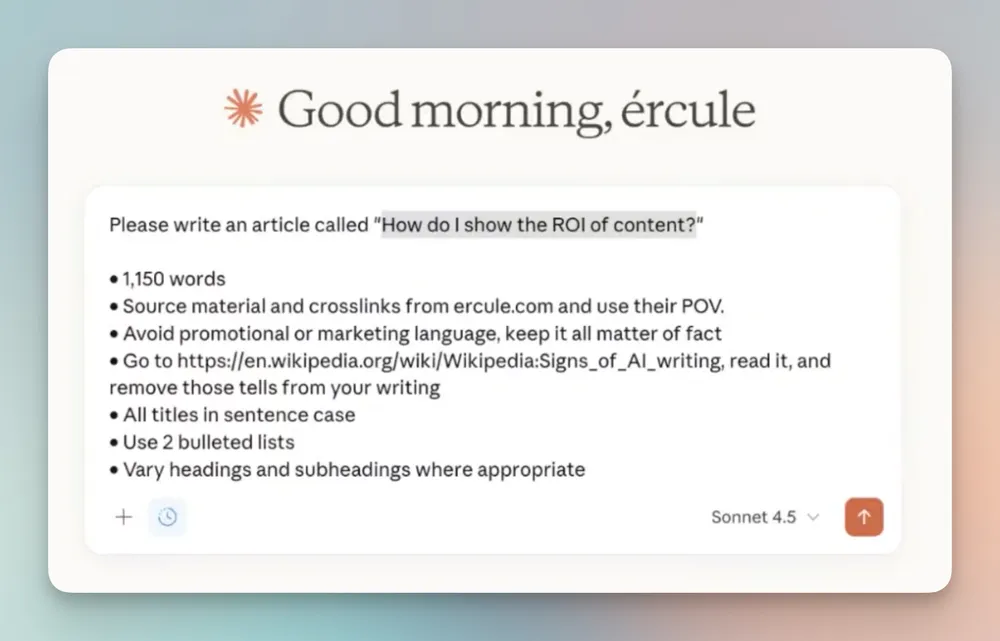
I give Claude short writing prompts like this one
Write an article called “How do I show the ROI of content?”
- 1,150 words
- Source material and crosslinks from ercule.com and use their POV
- Avoid promotional or marketing language. Keep it all matter of fact.
- Go to https://en.wikipedia.org/wiki/Wikipedia:Signs_of_AI_writing, then read the post and remove those tells from your writing.
- All titles in sentence case.
- Use 2 bulleted lists
- Vary headings and subheadings where appropriate

Let’s dissect the prompt. Each bullet point in the prompt falls into one of three main prescriptive categories:
- Narrative + perspective
- Technical specifications
- Style
Let’s look at what each one is doing.
Narrative + point of view
Two elements of the prompt give fundamental direction for the narrative:
- Subject: “Write an article called ‘How do I show the ROI of content?’”
- Point of view: “Source material… from ercule.com and use their POV”
You'll notice that I did not ask the LLM to come up with the title on its own. I chose the title myself, based on my research. (Again: this step is really important because LLMs are prone to making stuff up.) You can tweak the title later, after working out the article a bit, but at the outset you want to give uh LLMs that guidance.
The source material is crucial to this first prompt because LLMs need guidance when it comes to point of view. Without source material to reference, Claude won’t ever be able to write content that feels organic and true to your brand.
Source material needs to be human-generated. LLM-generated material doesn’t work as a source because it isn’t unique to your site. This is one major reason why human writers remain invaluable to a company. A human being needs to write the big white paper, do the interview, bring the theme on, look through the customer questions, and come up with some basic responses. That kind of content requires an investment.
Technical specifications
Simple specs here:
- Word count: “1,150 words”
- Cross links: “crosslinks from ercule.com”
I usually say 1,150 words. You can try whatever word count you want but my point here is this: I do not ask Claude to write a magnum opus. Quite the opposite, actually. I’m specifying a pretty modest word count to get started. I also don't ask it to write something super short. I think 1,150 provides a good amount of material to start off.
Crosslinks are important for a few reasons. On the technical side, we want every article on a website to provide opportunities for readers to follow their curiosities and explore other relevant pages on the site. Crosslinking is good marketing. Also, as noted above, the pages that will be cross linked will also serve as source material for Claude.
Style
My style notes address everything from tone to punctuation:
- Tone: “Avoid promotional or marketing language. Keep it all matter of fact.”
- Form: “use 2 bulleted lists”
- Headings: “Vary headings and subheadings where appropriate”; “All titles in sentence case.”
- Copy edits: “Go to https://en.wikipedia.org/wiki/Wikipedia:Signs_of_AI_writing, then read the post and remove those tells from your writing.”
Put your own tone guidance here – and you really should customize it to your brand’s unique voice. (Copy-paste freely from your brand style guide if you have one. If you don’t have one, you can get a quick-and-dirty style guide by telling Claude to review your website.)
All of us, as readers, are getting better and better at sniffing out AI-generated content. That’s why my prompt directs Claude to review the Wikipedia page for AI writing tells.

Wikipedia keeps this up to date. They've spent a lot of time thinking about what stuff.
My prompt specifies only “2 bullet lists” for basically the same reason: LLMs are not good at making sophisticated stylistic choices. ChatGPT, in particular, will overload a blog post with bullet points.

One personal style rule that I have for a basic post: two bullet lists and no more. Yes, I’ve broken that rule in this post but only after the kind of stylistic consideration that only humans can handle.
If Claude’s initial output still has a bit of the AI stink on it then I’ll repeat the instruction again later.
I revise natively in the Claude chat window
I keep it the entire process in this one thread. LLMs are very responsive editors so next I’ll ask it to make specific edits.

The first edit I’m going to request is one that I often request from human writers, too.
“Remove the first two paragraphs and the first header.”
I want the article to jump right into the substantive stuff. If I do need a few intro sentences, I’ll add them later on, after the full article has taken shape.
The blog post I’m writing with Claude here (working title “How do I show the ROI of content?”) is not a sprawling report or a hyper-detailed study. It’s a response to a practical customer question. The post should provide some specific answers and include my agency’s point of view.
Again: this is a process that is adapted from my experience writing countless articles. This kind of editorial expertise can’t be trusted to Claude alone.
I scan for sections to remove or revise
Specifically, I’m looking for sections that seem irrelevant, generic, or suspect.
Right away I see some material that is pretty generic: a section about Google Search Console metrics. Our blog doesn’t have much material. Without guidance on the topic, Claude made some pretty broad assertions.

The recommendations it offers are not recommendations that we make at ercule. So I’ll tell Claude to revise that assertion: “Content ROI also depends on whether it ties to revenue. Please include some metrics about that.”
Note: somebody with expertise will need to read this copy after I export it from Claude. I don’t trust LLMs to vet a piece of writing for factual errors. Again, this is where human writers are irreplaceable.
I look for substantive points to expand
While I’m looking for vapid points to delete I’m also looking for the good stuff. Here’s one standout statement from the draft:
“A page with 10,000 monthly visitors matters more than one with 100 visitors. Maybe this may sound obvious, but teams often optimize the wrong pages first.”
But is it worth expanding? There’s no data citation. Probably not worth trying to save.
Let’s look at another: “Start with business outcome metrics.” Not a game-changer but it’s helpful advice, in my opinion, so I’ll leave it in for now.
Here’s an interesting subheader: “Build reports that connect content to outcomes.”

This might even warrant its own separate piece of content. We could explore it in more detail, answering follow-up questions like, “How do I create these reports? Where should I create these reports? How do I think about it?”
As I review the draft I’m also keeping an eye out for crosslinks.

This iteration has a few already. This is encouraging because it implies that Claude actually consulted these pages in generating this part of the draft. And, as I mentioned above, it’s going to encourage click-through on the published post.
There’s always thin content to take out
The first draft I’ve generated has a lot of breezy sections. If you’ve ever created anything at all with LLMs, you are well aware of this phenomenon.
For example, there's a long, dubious section about “calculating the dollar value of content.” The premise is broad, the support is thin. It’s not going to work. So I’ll instruct Claude to delete this section and expand another section which feels more legit.
The rest of the revision process is mostly a matter of identifying bits to cut and bits to expand until every section seems fundamentally relevant, clear, and reasonable.
When that’s done I’ll export the draft and send it to one of the brilliant writers or editors on the ércule team to run a final quality-assurance review.
Bonus points: provide more context at the outset
The process I’ve run through here is really bare-bones but it’s one that I still use in a pinch. You can use it, too.
You can also make it more robust by adding more brand and subject information with the initial prompt. If you have a ten-page brand style guide, for example, then you should relay that info to Claude. Has your company published a white paper on the topic that you’re asking Claude to write about? Let the Claude agent know!
Attach a document that contains previous content, or record yourself talking about the subject matter. Use whatever format is most accessible to you. And I must stress again: only use human-generated content when providing context to Claude!
The entire composition process takes me about an hour
Is it going to be as good as human created content? No. But it'll be pretty good. With original research provided at the outset, and an editorial pass from my in-house team, the article could be useful, relevant, and clear.
It’s a huge opportunity for writing and marketing teams to expand their organic content coverage. A couple years ago this kind of output was unthinkable.
Next steps
You really could take the prompt that I used in this post and tweak a few phrases so that it fits your own company. Then drop it into Claude, or whichever LLM you prefer, and see how it goes.
Choose a blog title that you already have queued up for this quarter, or spend half an hour digging up some actual audience questions. The time you invest in research and customization at the outset will pay off exponentially in the long run, I promise.
Claude is a tool like any other. The sooner you start experimenting with it, the sooner you’ll figure out how it can serve you.