


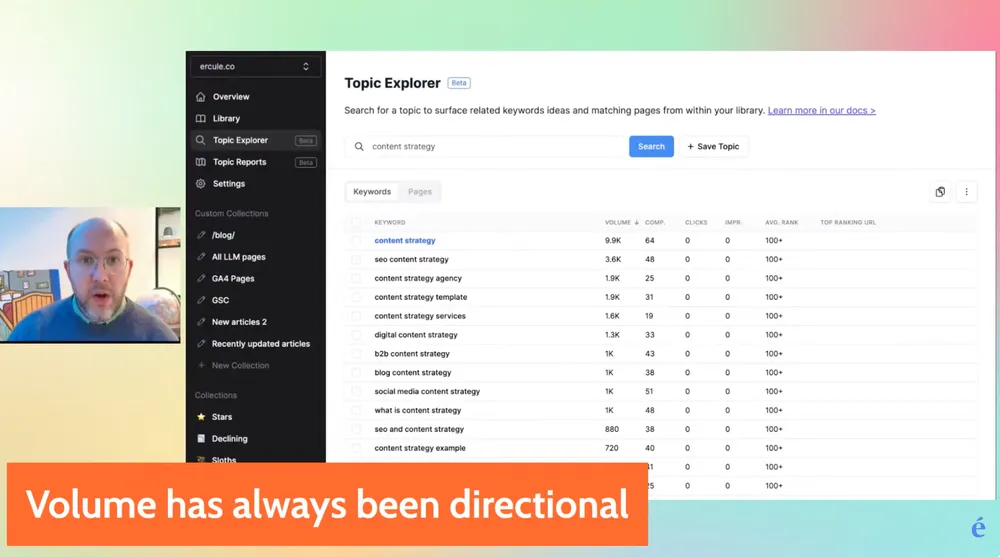
Don’t get me wrong: keyword volume is still useful! I use it for introductory topic selection to this day. But when it comes to creating valuable content that actually converts… keyword data is insufficient.
It’s not being replaced, per se. It’s being amended.
We all have access to a wealth of more granular data these days. Community research, customer transcripts, and LLM queries build on the foundation that keyword data lays out. That’s the kind of data I’m looking at in this article.
TL;DR
- Community research surfaces trendy debates and authentic language
- AI synthetic queries expose nuanced concerns beyond keyword data
- Sales and support transcripts identify real friction points
Keyword volume data has never been exact
The keyword data you get from a tool like SemRush or Ahrefs have always been (well informed) estimates. The ércule app automatically refines those metrics with Google Search Console data but keyword volume remains a fundamentally inexact metric.
It does provide a very useful estimate of a topic’s popularity. I’m talking about orders of magnitude rather than specific numbers. Is the keyword volume 10 searches per month, for example, or 250?
Occasionally, a blog post will target a keyword that has zero search volume and wind up generating a ton of search traffic.
Steve Toth writes about such examples from time to time.

I’ve seen it happen myself. It doesn’t stop me from using keyword data in strategic calculations. (It doesn’t stop Steve, either. As he notes in the above post, he is seeking out keywords with zero search volume.) At the same time, we’re all deprioritizing keyword data due to inconsistencies like this.
Keyword volume still plays an important role
Early stages of content strategy benefit the most from basic keyword research. For example: when a client comes to me and says, “We want to rank for [Some Obscure Topic].”
In that case, I’ll pull up some basic keyword data to see if there is any evident interest in the brand’s chosen topic. Sometimes the answer is No: “There’s no search volume for this topic, so there’s no evidence that anyone cares about it. We don’t think it’s worth your time.”
So keyword volume gives us a reliable, if broad, sense for a topic’s popularity. It’s still, arguably, the most important data set for the content strategies I build – but it’s far from the only data set.
Granular data is augmenting the role of keyword volume
We don’t create content simply to show up in search results. We create content to catch the attention of our audience, provide useful information, and ultimately make somebody fall in love with a brand.
This is not to diminish the use of keyword data. In order to catch the audience’s eye we need to first show up in their search results. But, as marketers, we can do all of these things at once. We can engineer content that is not only visible but timely and compelling.
To do all of that, you need to identify real questions that people in your audience are actually asking. I use AI to help collect this kind of data but it really come down to old fashioned marketing research tactics.
So let’s look at other data sources which build on the foundation laid by keyword research.
Real questions from community platforms
Traditional keyword tools might show you that "demand generation metrics" has a search volume of 120. Reddit discussions reveal the nuanced language your audience actually uses when wrestling with that issue. The Reddit thread shown below has dozens of upvotes and an ongoing debate in the comments.

It’s not just Reddit, by the way. These questions are waiting for you in Ycombinator and LinkedIn and pretty much any community-based platform that your audience uses. By systematically monitoring them, whether manually or through AI-assisted workflows, you can extract dozens of authentic questions that inform more resonant content.
Synthetic queries from AI search tools
At the moment, I’m a big fan of synthetic query data. Synthetic queries are the additional searches that an LLM automatically generates and runs on your behalf when you ask it a question.
For example, let’s say you ask ChatGPT "What's the best CRM for small businesses?" In order to build a comprehensive answer, GPT might internally search for related queries. Queries like…
- "CRM pricing comparison”
- “small business software reviews”
- “CRM implementation costs"
I use an LLM workflow to collect synthetic queries. By collecting this data, marketers can understand not just what users are typing into AI search, but what AI thinks they need to know. Some marketers even examine network traffic to see what ChatGPT is actually searching when processing queries (which requires some mighty technical implementation).
Sales call and customer support transcripts
Your sales people and customer success teams hear the most important questions every single day. The transcripts of these calls and chats are goldmines for content strategy.
Extract them systematically with whatever AI-based transcription tools you prefer. (Bigger companies use an enterprise transcription platform like Gong but there are a ton of free options.)
Turn the customer questions, and your answers, into dedicated FAQs or blog posts. Borrow the phrasing and framing from actual customer transcripts whenever possible. Optimize the new content for LLM search. The next time someone types that question into ChatGPT, your page should be easily cited.
Google Trends is useful, too
It won’t provide more granular data but it can be a quick substitute for that traditional keyword data. And if you’re increasingly using keyword volume to answer basic, directional questions, you can get a lot of directional insights these days from Google Trends.

It has gotten a lot more useful over the past year or so. In the example above, I searched for the term “marketing measurement.”
The “Top queries” column shows the search terms most frequently searched alongside your keyword within the same search session. “Rising queries” column shows the terms with the most significant growth in search volume compared to the previous time period.
So if I cared about marketing measurement I might say, “Oh influencer marketing measurement. Okay there's some other stuff here that's interesting.” This can be really handy for optimizing one-off pieces of content, too – webinar recaps, whitepaper adaptations, stuff like that.
We’re not getting rid of keyword data!
We’re augmenting the role it plays in our strategies. It will remain the foundation of my content strategy plans for the foreseeable future. At the same time, I’m super excited about all the different ways we’re able to supplement that data.
Granular data grows even more important as we scale up content production with LLM technology. If keyword data tells us what to write about, all of this granular data tells us how to write about it. All writers could use that kind of guidance but LLM writers absolutely require it.
At the end of the day, the basic plan for marketers hasn’t changed. We’re still trying to help customers solve their biggest problems. Granular data enables us to be more systematic about it.