


The best marketers I know aren’t outsourcing their decision-making to AI. They’re using AI like a research and editorial assistant.
That’s what excites me most at the moment: using AI for research and analytical support. Simple workflows will collect original data and crunch the numbers in an instant so that marketers can build more creative and complex campaigns.
In this post I’m highlight three ways that AI enables more robust content systems:
- Identifying new engagement opportunities
- Gauging the health of your content system
- Allocating production resources in a smarter way
But first let’s set some basic terms.
What is a content system?
A content system is a set of processes, people, and technology that takes everything your people know and turns it into what your buyers need to learn.
A strong content system turns your team’s knowledge into structured information, a.k.a. content. It formalizes the processes that go into research, production, distribution, and measurement so they become repeatable, reliable, and effective.
Buyers are looking for help and information that your team can provide. That knowledge and support are embedded in your product. A content system provides the means to consistently serve buyers in that way.
AI workflows identify new marketing angles + opportunities
The research potential for marketers using AI really can’t be understated. I’m talking about real-time audience research: digging around the communities and platforms where your ideal customer hands out.
Whether your audience hangs out on Hacker News, or LinkedIn, or Reddit, you can use AI to find the liveliest conversations and suggest ways that your team might contribute to them.
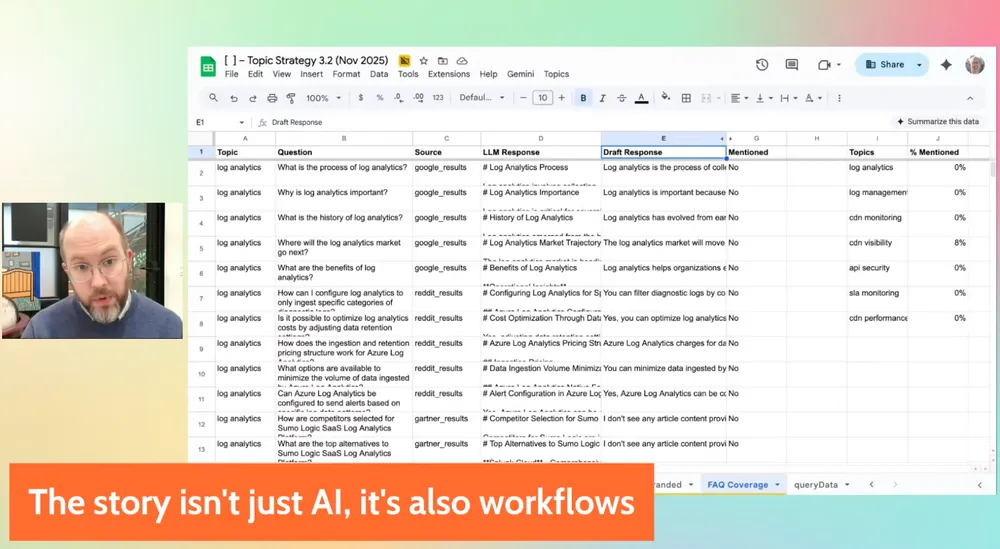
AI workflows (like the FAQ finder shown below) deliver that information. Choose any topic that you might be considering for a new campaign. The workflow will return with community research.

If you’re toying with a new theme for the coming quarter (like “log analytics” in the example above), this kind of audience data will show you what people are actually talking about.
Again, this isn’t a replacement for a marketer’s decision-making. It’s supplementary research that enables more informed decisions about the topics, channels, and narratives you invest in. (More on that below.)
Use AI to measure the health of your content system
The ideal content system is prolific and consistent. It’s publishing content that grows your audience and converts leads and is doing so in a way that your team finds sustainable.
Getting to that state of peak performance requires a mix of internal metrics (like content velocity) and external metrics (like lead conversion).
Hubspot might give you lead conversion data but content velocity requires a more hands-on measurement. LLMs are great at collecting and crunching the unique data you need.
Example: assessing brand presence in search
Basic AI workflow platforms allow you to quantify and qualify your brand presence in Google and LLM search. We use one that will query different search engines and LLMs, quantify the results, and qualify the brand mentions.
In a matter of minutes the workflow will collect that data and present it all with granular analysis of each instance.
- Does it reflect our current positioning?
- Does it make sense or not?
- What’s the exact language being used?
Here’s what the output looks like for the DIY workflow that I use.
With this tool we’re using AI to figure out what your brand looks like to people on the outside.
It’s one indicator of your content system’s health.
Again: it’s not replacing the decision-making faculties of marketers. It’s simply providing data and analysis at a new scale.
AI enables smarter allocation of production budget
This is an emergent use case for AI that I’m super excited about. It builds on the previous two use cases. With a more comprehensive view of content opportunities, and a clearer sense of your team’s capabilities, you can stretch your budget to cover more ground.
As the buyer journey becomes more varied, the number of channels increases, and competition grows more intense. Marketing strategy becomes more of an allocation model, not only for channels but also for production.

Where are your people’s hours best allocated?
This isn’t a new question for CMOs but, in the age of AI, the answers to the question are more dynamic. It’s not simply a matter of assigning a real writer to one piece and using turnkey AI for another.
When we talk about outsourcing some content tasks to AI, it’s a question of magnitude. For content with low ROI (i.e. top-of-funnel content) you might have AI run rough drafts for in-house writers.

For content with high ROI and a prestige audience, we’ll want to make sure that the best writers have ample time to spend on getting that stuff right. Ideally, they’ll have more time to devote to this content when AI is helping out with lower-priority pieces.
No matter how you feel about AI support in the writing process one fact is undeniable: we’re able to make all of these marketing decisions in a more systematic, repeatable, reliable way than ever before.
We’ve come so far in one year…
Nine months ago, I saw a lot of AI prompts being exchanged on LinkedIn. Like this post of mine which shares an AI prompt for content editors.
It almost seems quaint now.

Prompt design is still extremely important but it has also become table stakes. Most marketers I know build little repositories for their prompts, even if it’s just in a Google Doc.
A few years ago, this kind of discussion might have sustained the marketing community all year long but, nowadays, we’re all moving incredibly fast.
We started linking prompts within workflows
Individual prompts are still impressive, but within a few months we were linking them together in workflows to complete mighty complex projects. I documented my first workflow in this post from March 2025.
The version of Justin who wrote this post is a noob. TLDR: It's fine. Very interesting. Not amazing.

Within nine months of writing that post, our agency had something like 100+ workflows that we were running for different clients. We were using them for research, for experimental content, for programmatic content, for website audits, LLM brand audits…
Now let’s talk about the year to come
I don’t imagine that the integration of AI in our industry will slow down any time soon. Now that these big changes are underway, the process might feel less jarring. Regardless, let’s take a moment to appreciate getting through this very strange year.

As for next year? At ércule, we’re working on AI agents that we can provide to agency clients. Agents will allow our clients to use AI in the ways I’ve been describing without having to worry about any coding or back-end business.
These workflows can do anything from spellchecking your website to drafting new product-focused content and then publishing it directly in your CMS. It’s awesome. But making that truly accessible for marketers will require an agentic, chat-based component.
As the daily obligations of a marketer grow more varied, the systemic approach to content is going to be more and more essential. Are jobs are less about editorial decisions and more about the orchestrations of processes and people and tech. If we can keep that in mind then I think we’re all in a great position for the coming year.