


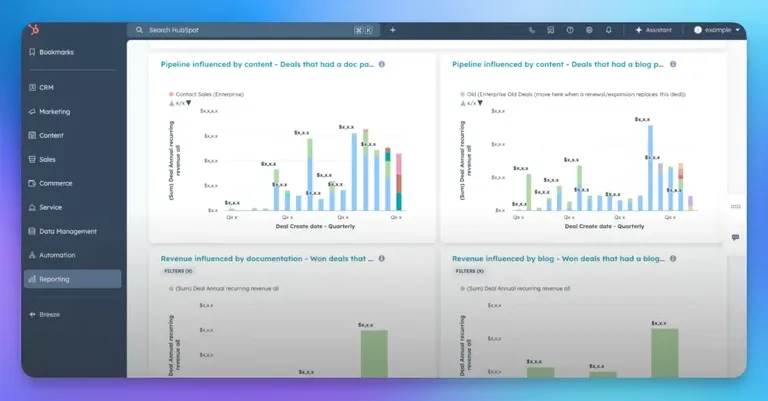
You get into marketing to tell stories, and play with language, and then you learn that CFOs love one story above all others. One that depends more on analytics than poetics.
How Your Content Contributes To Sales... It’s not an easy tale to tell. There are countless ways to confuse, disappoint, and/or bore the execs in the audience.
(I get a kick out of helping my artsy, right-brained marketer friends find the story they’re looking for in conversion data.)
There are countless ways to read, and mis-read, conversion reports. I wrote down some of the most common offenders.
Fixating on first-touch data
First-touch data tells a compelling story but it’s a linear story. These days, the buyer’s journey is increasingly non-linear. Not nearly so tidy as it was in the golden era of SEO. First-touch can’t really capture that fact.
You wind up with limited data sets and, more dangerously, you overlook content that is doing important work farther down the pipeline. Besides, even if the data comes out looking okay, the story itself feels pretty one-dimensional. Unlikely to thrill your CFO.
Try measuring influence instead of first-touch
Rather than overstating the effect of individual pages, measure performance in terms of influence. A sales lead might look at a dozen pages on your site before converting. Each of those pages influenced the journey.
It’s a less determinative lens of analysis but also more true to the modern buyer experience. Increasingly, buyers veer away from a brand website on their journey before coming back to convert.

Simple analytics can reflect that complex reality. A simple GA4 report (pictured above) will get you there. The create a segment of everybody who's converted on your site and identifies the pages that those people looked at on their way to conversion
Losing the CFO in the weeds
I’m as guilty as anyone of getting a little too enthusiastic about big heaps of data. It’s easy to forget the marketing 101 rule: don’t bury the lede.
You can read any report a dozen different ways and get a dozen different valuable insights but most of them will probably bore your stakeholders. Or confuse them. Or lead to unhelpful questions.
Are you trying to prove impact? Or tweak your strategy? Or figure out the next phase of investments? Hubspot analytics will tell any of those stories. But when you’re talking to the CFO you should probably just choose one…
Lead with the impact narrative
In my experience, the finance people want to get down to brass tacks. It’s a pretty simple outline:
- Here are the topics where content is influencing pipeline.
- Here is how we sustain / increase that influence
- Here are the areas where we think we can break new ground

What’s not working? These same reports will tell you that too but that’s a topic for a different meeting. (An internal, close-door, marketing team meeting.) No need to harp on your failures while the stakeholders are around.
Settling for sloppy HubSpot implementation
This is a tale as old as analytics and yet it never seems to go away. Here are a few classics in the genre:
- HubSpot can’t actually see your website. If HubSpot can’t track the buyer’s journey to your store then you have essentially no information about the buyer’s journey (let alone the influence of content on that journey).
- Funnel stages are equivocated. Some companies include the content engagement in the Closed stage, for example. There are a lot of factors at that stage beyond the control of marketing/content so this approach is going to warp your numbers.
- Individuals are over-valued in the conversion pipeline. The people connected with a deal aren’t necessarily the people who are actually making purchase decisions at a company. It helps to approach these leads from more of an account-based perspective.
This stuff is maddening in its complexity sometimes, especially when you’re selling to companies that use buying committees.
I wish I had a clever solution for this problem but alas, there is no substitute for the fundamentals. Take your time, make sure everything is firing as it should. That’s it.
Lowballing your attribution numbers
It’s all too easy to say, “This is the conversion volume for a page.” In actuality that data is showing something much more specific, like, “The number of people who we were able to cookie that eventually ended up converting whose names we know that were correctly attached to a deal.”
Context matters! Reading the data is an art unto itself. If half of the people who visit your site are blocking cookies then your conversion volume numbers are only going to represent half of the conversions.
Wouldn’t you like to double the conversion volume that you’re showing to the CFO? And know that you did so out of an obligation to the truth?
Qualify the data and its collection
“We also know that half the people on the site are blocking cookies and therefore it's probably 2x the data.” This kind of qualification will always be an estimate. Still, it’s more accurate than the raw values that Hubspot spits out in that instance.
This applies to the limits of the data tools themselves. You need to know how often the Hubspot pixel is firing on your site. It might only be firing 55% of the time, in which case you’re only catching 55% of conversions. If you don’t have that context then you don’t really have clean data.
The stakeholders on your team deserve this kind of clarity. They also deserve to know about the steps in the buyer’s journey that aren’t represented in the analytics. The off-site processes.
Reminder: analytics can’t ever fully replace messy, human discussions
Data allows us to tell clear stories but we also need to acknowledge the limits of these stories. Buyer behavior is infinitely complex. Figuring out the next steps for a campaign requires messy, human conversations. Attribution data tells you what is going on but they can’t really speak to the “why” of the situation.
You might have data that says some campaigns are working more than others. The messy conversation will center around figuring out why, exactly, these performances are working. Are they working because we already have an audience on this topic? Or is this a new area where we’re building authority? Are we piggy-backing off some other attention?
Brand strategy always requires a certain amount of qualitative, squishy, human insight, too. Sometimes you just need to have a messy, non-algorithmic conversation about what the balance is for you. What’s the other option: not going for it? Not exploring your options? Falling back on common assumptions? That’s a recipe for seriously tired storytelling.
