


When buyers start researching products with platforms like Claude or ChatGPT, the AI tries to cite “third-party” sources that are (ostensibly) neutral. This can span everything from user review sites like G2, to Reddit message boards, to the websites of independent bloggers.
How worried should marketers be about third-party influence on their search presence? What can you do about it? That’s what I’ll be addressing in this article. While you can’t quite control what other people write about you, there’s a surprising amount of influence you can have on the conversation.
I’ll examine some recent industry reports — one from Wix and another from AirOps – that measured the frequency of third-party (or “external domain”) citations in buyer research.
“Third-party” is an extremely broad category
I’m going to use this term in the same way that it’s used in those Wix and AirOps reports.
In that context, “third-party” basically means this: a website that is not one of the brands being compared. Ideally, the AI pulls from robust, journalistic, monastically ethical websites. In practice, there’s a lot of wiggle room there for biases and vested interests.
Sometimes AI is drawing from fairly neutral user-review sites like G2. Other times it’s citing the work of clever marketers. (And in the absence of third-party options, it will use “first-party” content from you and your competitors. More on this below.)
Most search responses include a mix of sources
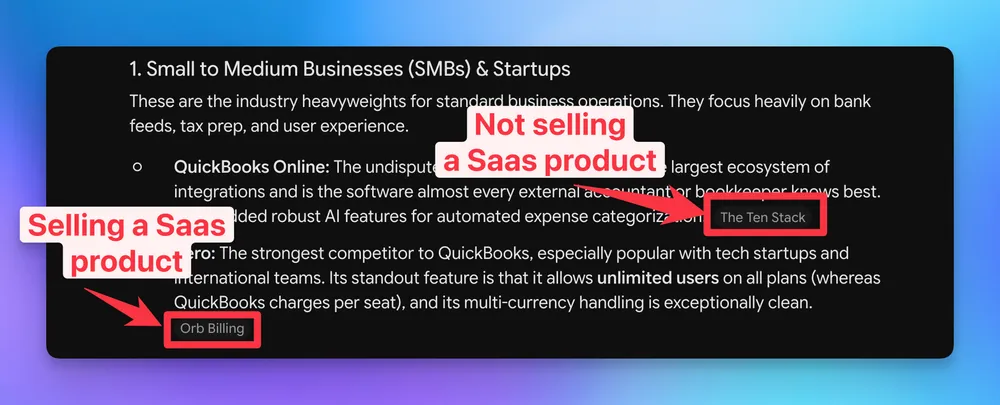
For example: I typed a simple research query (“best accounting software”) into Gemini. The AI repeatedly cited the two sources. These two websites have very different aims.

One is a relatively neutral product review site (The Ten Stack), while the other (Orb Billing) is a Saas product website making a marketing play.
Technically, you could say that Orb is a third-party site because it doesn’t sell accounting software. However, it does sell billing software, which means that its audience overlaps with the buyer audience for accounting Saas products.
The product review article on Orb’s blog website is a clever play. And it succeeded! (At least it succeeded with Gemini (at least for this particular search).)
Every AI platform sources in a different way
No two query responses are ever exactly the same with AI search but the platforms do show certain structural tendencies and biases.
Perplexity tends to cite community platforms, like Reddit, alongside more typical listicles. That trend, cited by the Wix report, is evident in our sample search, too. 👇

ChatGPT and Claude are more likely to supplement with articles rather than community discussions.
They all seem to love a third-party listicle
At least when it comes to the discovery phase: “What are the best products in category XYZ?” More than 80% of the time, AI’s response will cite data from a third-party website (i.e. not a brand website within that product category).
Two recent studies came to this same conclusion. According to a recent AirOps study, this is the case 85% of the time.

A recent study by Wix clocked the rate closer to 80%. The Wix study goes one step further, quantifying the content format most often cited in those “best product” queries. Listicles are at the top of the list.

You’ll also notice that articles and product pages are two most common formats, after listicles. This chart is measuring overall frequency. Let’s dig into the data and see how it shifts with phases of the buyer’s journey.
Branded content is cited more often down the funnel
It bears repeating: the emphasis on listicles seems very much tied to “discovery” phase buyer queries. The farther down the funnel you go, the more frequently product pages are cited by AI.

In some ways, this shouldn’t come as a surprise. The farther down the funnel you go as a buyer, the more you’re getting into the details of products and pricing and use cases.
All that is to say: ChatGPT and Claude and Perplexity are pretty good about assessing what categories of content are most useful for buyers at different stages.
Remember, these are just citations
The goal, in the early buyer journey stages, is simply to be mentioned by AI. These third-party sites influence which brands are mentioned at all.
They’re not necessarily influencing conversion. Click-through is markedly low with AI search at all stages. And while ChatGPT might cite a third-party listicle, it’s still likely to put the product homepages front and center for the user.

Which is to say: this third-party stuff is important but it’s not everything. It’s one part of a broader system in which branded content plays a big role, too.
When third-party reviews aren’t available…
AI will cite plenty of first-party sources. Some product categories are so new and small that no outside observers are writing about them.
That won’t slow down ChatGPT or Claude from giving you an answer, of course. These AI platforms are committed to providing answers based on… whatever is around.
Here’s a more flagrant example from the same ChatGPT search mentioned above. I scrolled down a bit through the “Sources” tab and quickly found a blog post from an accounting software product’s website.

This isn’t my favorite marketing play, I must admit. But, at the same time, I’ve seen it work. And, in the example above, there were numerous instances of it working.
You can create content for a play like this that is actually useful for readers and honest about its biases. Of course, lots of marketers go the quick and sloppy route with a play like this. So it goes.
Anyway, if you’re working in an extremely small, niche space, and spot a gap like this, you might as well get in there before your competitor does.
Let’s not forget that unspoken 20% of citations
As Wix and AirOps both assert in their reports, ~80% of top-funnel citations are third-party.
This means that, ~20% of the time, AI is citing first-party websites, a.k.a. promotional websites, a.k.a. blog posts where a company lists the “10 Best Saas Products” and lists themselves as #1. Again: it’s not my favorite content play but 20% of search queries is nothing to bristle at. Especially for high-volume queries.
Is it really worth your time to create this kind of content? The kind that is unlikely to be cited and is treated and runs a risk of rubbing people the wrong way? It’s probably not worth much time, in my opinion. And, with a well engineered AI production workflow, you can produce content like this with minimal investment, just to cover your bases. As long as you provide substantial context to the workflows you can expect a decent quality of output.
You can influence third-party sites, too.
And you can do so in a forthright, non-spammy way that actually provides clarity for your audience. (You can do it the spammy way, too, but is that how you want to live your life?)
The most legit of these sites are driven by product users and communities. With user review sites like G2 you can often refine and update your core product information. If your product description is incorrect, for example, you can request changes. Often you can edit it yourself, as a user. You can update Amazon partner listings in this way.
When users are debating your product on Reddit you can join the conversation – especially if misconceptions about your product are being pushed. Of course, you don’t want to be sales-y or spammy about it (though that does seem to work for some nefarious marketers). Engage in good faith.
You can also address any misconceptions via content on your own website. If rumors are circulating about your product on LinkedIn then you can address them directly in an FAQ, for example, or a blog post. The content on your homepage seems to carry more weight for AI than random community contents do.
And, if you have the time and inclination, it never hurts to reach out to independent blog sites that might mention your product. The juice isn’t always worth the squeeze here but it’s definitely an option.
Remember: it’s one part of a vast content system
Third-party sites and AI search are individual elements of a complex content system. Each is important in its own right, and the two are intertwined.
- Make sure your messaging is clear across the site. This is important for buyers, of course, but also for AI crawlers and any potential product reviewers.
- Documentation should be clear and accessible. Docs content is marketing content. It’s one of the best ways for AI to understand what your product is all about.
- Identify the queries where branded content has the biggest effect. In order for any of these tactics to be effective you need to have a clear view of the target. You need to know what buyers are looking for in order to satisfy them.
To focus on any one component is to neglect the others. And, you know as well as I do, we all have a lot of bases to cover these days.